Securing a load with PP strap (polypropylene strap) involves two critical steps: tensioning and sealing. Both must be performed correctly for the strap to perform its function. Too little tension and the load shifts. Too much tension and the strap breaks or cartons are damaged. A weak seal fails under stress. Get either step wrong, and the load security is compromised.
At Jushuo Packaging, our field data shows that tension and seal failures account for a significant percentage of strapping-related load failures reported by customers. Understanding proper tensioning and sealing techniques helps operators achieve reliable, consistent results.
1. Tensioning Fundamentals
1.1 What Is the Right Tension?
The optimal tension is the lowest level that keeps the load stable throughout the entire journey. According to industry experts, apply just enough tension to hold the cartons together without compressing them, creating secure and stable loads without crushing .
For standard cartons, tension should be consistent across all straps. Variable tension levels often lead to uneven load distribution, causing some cartons to bear more pressure than others.
1.2 Factors Affecting Tension
Several factors influence the correct tension setting:
Load weight: Heavier loads require higher tension
Carton strength: Fragile or light cartons require lower tension
Strap width: Wider straps distribute tension over larger areas
Strap thickness: Thicker straps can handle higher tension
Handling conditions: Longer transit distances may require higher tension
Jushuo Packaging's engineering team recommends testing tension settings on sample loads before full production to determine the optimal tension for your specific application.
1.3 Tensioning Methods
Different equipment types use different tensioning methods:
Equipment Type
Tensioning Method
Typical Application
Manual tensioners
Hand-operated tensioning
Small volumes, field use
Semi-automatic
Motorized tensioning
Medium volumes
Fully automatic
Integrated tensioning
High-volume production
1.4 Common Tensioning Mistakes
Mistake
Consequence
Over-tensioning
Carton damage, strap breakage
Under-tensioning
Load shifting, product damage
Inconsistent tension
Uneven load distribution
No tension verification
Unknown tension levels
2. Sealing Fundamentals
2.1 Heat Sealing
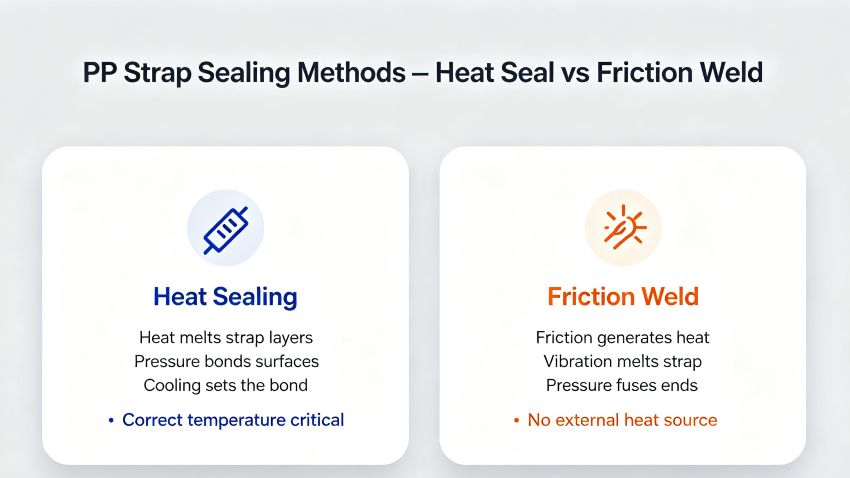
Heat sealing is the most common sealing method for PP strap. According to equipment manufacturers, heat sealing creates a strong bond by melting the strap surface layers under heat and pressure.
How heat sealing works:
Heat element heats the overlapping strap layers
Pressure bonds the melted surfaces together
Cooling period allows bond to set
Key considerations:
Correct temperature setting (too hot = burn through; too cold = weak seal)
Proper pressure (ensures contact between layers)
Sufficient cooling time (allows bond to develop)
2.2 Friction Welding
Friction welding is another sealing method. According to machinery specifications, this method uses heat generated by friction to bond the strap.
How friction welding works:
Strap ends are held together under pressure
Vibrating element creates friction and heat
Melting fuses the strap ends together
Advantages:
No external heat source required
Fast cycle times
Strong, consistent seals
2.3 Seal Strength Verification
According to packaging quality standards, seal strength should be verified regularly. Key methods:
Visual inspection (check for complete bonding)
Pull testing (verify seal holds under tension)
Batch sampling (test random seals from production)
Jushuo Packaging's quality assurance recommends regular seal strength verification using a pull tester.
3. Step-by-Step Sealing and Tensioning Process
3.1 Manual Strapping
Step 1: Feed the strap
Feed the strap around the load
Insert the end into the tensioner
Step 2: Tension the strap
Apply tension using the tensioning tool
Stop when desired tension is reached
Step 3: Seal the strap
Position the sealing tool over overlapping strap ends
Apply heat (for heat seal) or vibration (for friction weld)
Allow bonding time
Step 4: Cut and inspect
Cut excess strap
Verify seal strength visually
3.2 Automatic Strapping
Step 1: Load placement
Position the load in the strapping machine
Ensure proper alignment
Step 2: Automatic feeding
Machine feeds strap around the load
Strap ends meet in the sealing head
Step 3: Automatic tensioning
Machine applies pre-set tension
Tension sensors verify correct levels
Step 4: Automatic sealing
Machine seals using heat or friction
Seal quality verified automatically
3.3 Post-Sealing Inspection
After sealing, operators should inspect:
Seal appearance: Complete bonding with no gaps
Strap tension: Not too tight or too loose
Strap position: Properly positioned on load
Load security: No shifting or movement
4. Equipment Maintenance for Consistent Results
4.1 Regular Calibration
According to equipment manufacturers, regular calibration ensures consistent tension and sealing quality. At Jushuo Packaging, our technical support includes calibration guidance for strapping equipment.
4.2 Wear Parts Replacement
Worn components cause inconsistent results. Replace regularly:
Sealing heads
Feed wheels
Tension sensors
Guide components
4.3 Operator Training
According to quality management standards, operator training is essential for consistent results. Training should cover:
Equipment operation
Tension settings
Seal quality verification
Troubleshooting
Summary
Properly sealing and tensioning a PP strap is essential for load security and packaging reliability. Correct tension—enough to secure the load without damaging cartons—is the foundation of effective strapping. Seal strength determines whether the strap maintains its tension throughout the journey. Heat sealing and friction welding are the two primary sealing methods, each with specific requirements and verification procedures.
For operators, the key principles are straightforward: apply consistent tension appropriate for the load and strap, verify seal strength regularly, and maintain equipment through calibration and wear parts replacement.
Jushuo Packaging offers comprehensive PP strap solutions with documented quality assurance and technical support. Our manufacturing capabilities—5 PP production lines with 20,000 tons annual capacity—ensure consistent performance across all specified dimensions. We support clients through operator training, equipment calibration guidance, and application optimization.
If you need assistance with PP strap tensioning and sealing techniques or have questions about best practices, please send an email to sales@jushuopackaging.com, and our professional team will provide one-on-one support.
References
Signode Industrial Group. “Strapping Tension and Sealing Guidelines.” Signode.com, 2025.
Brief: PET strap with smooth surface, commonly known as plastic steel strapping, is currently a new type of eco-friendly packaging material used worldwide to replace steel strapping & PP strapping.. ● Strong tensile strength, Low elongation, Strong heat resistance ● Good flexibility, Aesthetically pleasing & rust-free ● Width (mm): 9-25 ● Thickness (mm): 0.4-1.25 ● Break force (kg): 160-1360 ● Color, logo, printed characters customized accept ● Application: Cotton, wood, electronics, bricks, ceramics, building materials...
Brief: PET strap with smooth surface, commonly known as plastic steel strapping, is currently a new type of eco-friendly packaging material used worldwide to replace steel strapping & PP strapping.. ● Strong tensile strength, Low elongation, Strong heat resistance ● Good flexibility, Aesthetically pleasing & rust-free ● Width (mm): 9-25 ● Thickness (mm): 0.4-1.25 ● Break force (kg): 160-1360 ● Color, logo, printed characters customized accept ● Application: Cotton, wood, electronics, bricks, ceramics, building materials...
Brief: Trusted as a Manufacturer & Supplier, Jushuo Packaging offers high-strength PP strap built for demanding applications, featuring: ● Superior tensile force for heavy loads; ● Secure adhesion for joint integrity; ● Consistent, reliable quality; ● Robust performance under stress.
Jushuo Packaging is a OEM manufacturer of high-performance PP & PET straps, deliver zero-defect quality, 30- 50% cost savings vs steel, just-in-time delivery. Innovating for global industries with 10+ Yrs expertise.

 English
 العربية
 Français
 Русский
 Español
 Português
 Deutsch
 italiano
 日本語
日本語 한국어
한국어 Nederlands
 Tiếng Việt
 ไทย
ไทย Polski
 Türkçe
 አማርኛ
አማርኛ ພາສາລາວ
 ភាសាខ្មែរ
 Bahasa Melayu
 ဗမာစာ
ဗမာစာ தமிழ்
தமிழ் Filipino
 Bahasa Indonesia
 magyar
 Română
 Čeština
 Монгол
 қазақ
қазақ Српски
 हिन्दी
 فارسی
فارسی Kiswahili
 Slovenčina
 Slovenščina
 Norsk
Norsk Svenska
 українська
 Ελληνικά
 Suomi
Suomi Հայերեն
 עברית
עברית Latine
 Dansk
Dansk اردو
اردو Shqip
Shqip বাংলা
বাংলা Hrvatski
 Afrikaans
 Gaeilge
 Eesti keel
 Māori
Māori සිංහල
සිංහල नेपाली
 Oʻzbekcha
 latviešu
 অসমীয়া
 Aymara
 Azərbaycan dili
 Bamanankan
 Euskara
 Беларуская мова
 भोजपुरी
 Bosanski
 Български
 Català
 Cebuano
 Corsu
Corsu ދިވެހި
 डोग्रिड ने दी
 Esperanto
 Eʋegbe
 Frysk
Frysk Galego
 ქართული
 guarani
 ગુજરાતી
 Kreyòl ayisyen
 Hausa
Hausa ʻŌlelo Hawaiʻi
 Hmoob
Hmoob íslenska
 Igbo
Igbo Ilocano
 Basa Jawa
 ಕನ್ನಡ
ಕನ್ನಡ Kinyarwanda
 गोंगेन हें नांव
 Krio we dɛn kɔl Krio
 Kurdî
Kurdî Kurdî
Kurdî Кыргызча
 Lingala
 Lietuvių
 Oluganda
 Lëtzebuergesch
 Македонски
 मैथिली
 Malagasy
 മലയാളം
 Malti
Malti मराठी
मराठी ꯃꯦꯇꯥꯏ (ꯃꯅꯤꯄꯨꯔꯤ) ꯴.
 Mizo tawng
 Chichewa
 ଓଡ଼ିଆ
ଓଡ଼ିଆ Afaan Oromoo
 پښتو
پښتو ਪੰਜਾਬੀ
 Runasimi
 Gagana Samoa
 संस्कृत
 Gaelo Albannach
 Sepeti
 Sesotho
 chiShona
 سنڌي
سنڌي Soomaali
 Basa Sunda
 Wikang Tagalog
 Тоҷикӣ
 Татарча
 తెలుగు
 ትግንያውያን
 Xitsonga
 Türkmençe
 संस्कृत
 ئۇيغۇرچە
 Cymraeg
 isiXhosa
 ייִדיש
 Yorùbá
 isiZulu