The Packaging Dilemma
Every packaging professional faces the same dilemma: apply enough tension to secure the load, but not so much that cartons are crushed or deformed. When PP strapping is applied with excessive tension, it can cut into carton surfaces, weaken box structure, and compromise product protection. Too little tension, and loads shift during transit, leading to damage claims and customer dissatisfaction.
According to industry analysis, tension control is the single most important factor in determining strapping performance. Signode, a leading strapping manufacturer, notes that polypropylene strapping is designed for light and medium-duty applications including palletizing, unitizing, bundling, and carton closure and reinforcement . These applications require careful balance between security and carton protection.
At Jushuo Packaging, our production experience and customer feedback consistently identify over-tensioning as the leading cause of carton damage in automated strapping operations. Understanding how to prevent this while maintaining security is essential for packaging professionals.

1. Understanding the Balance: Tension and Carton Integrity
1.1 Why Over-Tensioning Damages Cartons
When PP strapping is applied with excessive force, the pressure creates stress points on carton surfaces and edges. These concentrated loads can crush boxes, break seals, transfer stress to products inside, and cause straps to cut into carton edges. The result is compromised product protection and increased damage claims.
Jushuo Packaging's field data indicates that carton damage from strapping accounts for a significant percentage of packaging-related claims in transit. In many cases, the damage is caused not by the strap itself but by its application.
1.2 Load Dynamics
Understanding how loads behave during transit helps determine appropriate tension. Cartons containing compressible products may settle during shipping, causing initial tension to relax and potentially leading to loose loads. Conversely, rigid cartons with minimal compressibility maintain consistent dimensions and respond predictably to strapping tension.
Load stabilization during transportation is essential for both product protection and safety . When cartons shift, product damage can occur even when the strapping tension itself is correct.
2. Tension Control Strategies
2.1 Determine the Minimum Effective Tension
The optimal tension is the lowest level that keeps the load stable throughout the entire journey. Industry experts recommend applying just enough tension to hold the cartons together without compressing them, which creates secure and stable loads without crushing .
For standard cartons, tension should be consistent across all straps. Variable tension levels often lead to uneven load distribution, causing some cartons to bear more pressure than others.
2.2 Account for Load Settling
During transport, cartons may settle or compress, particularly when stacked. Cartons lose tension during the shipping process as the product settles under its own weight and from the stress of being transported . This phenomenon is particularly pronounced for compressible goods.
To compensate for settling without over-tensioning initially, consider these approaches:
Apply moderate initial tension and allow load settling
Use retensioning systems where equipment permits
Adjust tension settings based on carton compression characteristics
Industry experts note that using a heavier-gauge strap may help reduce relaxation, but this also drives up material costs and may not be necessary if tension is properly managed .
2.3 Calibrate Strapping Equipment
Strapping tools and equipment with proper settings produce consistent tension and reliable seals, which directly affects the integrity and appearance of the packaging . Regular calibration ensures tension levels remain within specified ranges. Without calibration, tension can drift over time, causing sudden shifts in performance.
Industry analysis shows that many cases of carton damage from strapping result from poorly calibrated equipment rather than improper strap selection. Inconsistent tension created by calibration issues can produce variable results, with some straps over-tightened and others loose.
Jushuo Packaging's technical team regularly advises clients on strapping head calibration procedures and tension verification methods to maintain consistent packaging quality across production runs.
3. Edge Protection Solutions
3.1 Why Carton Edges Fail
Carton edges are the weakest points in box construction. When PP strapping tension is applied directly to a carton corner or edge, the force concentrates, compressing the edge and initiating damage. This is especially problematic for single-wall cartons or those with lower burst strength.
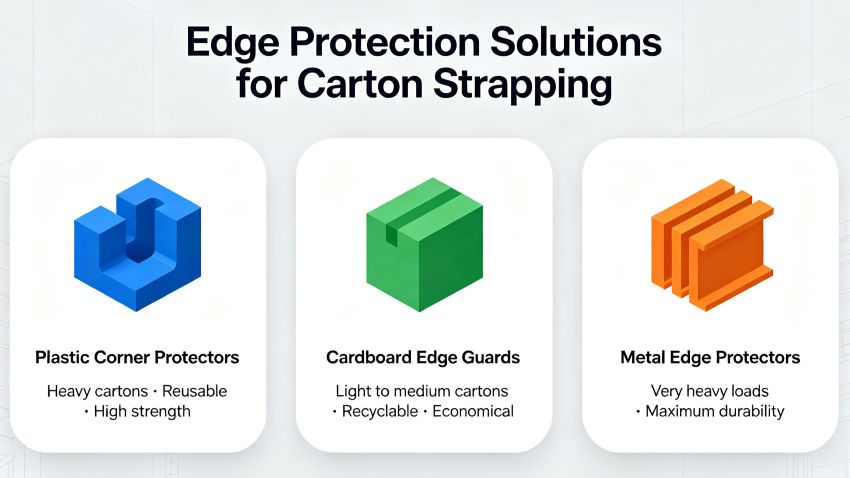
Using edge protection devices like corner protectors is essential when strapping cartons, particularly for heavy or fragile loads . These protectors are available in plastic, cardboard, or metal, each offering different levels of protection.
![Edge Protection Solutions for Carton Strapping]()
3.2 Edge Protection Options
| Protector Type | Best For | Advantages |
| Plastic corner protectors | Heavy cartons, multiple straps | Reusable, high strength |
| Cardboard edge guards | Light to medium cartons | Economical, recyclable |
| Metal protectors | Very heavy loads | Maximum durability |
Edge protection maintains carton integrity by distributing PP strapping pressure across a wider area. When these guards are used, the force of the strap spreads out instead of cutting into the box, which protects the goods and the strap from damage. These accessories help eliminate damage and improve the look of packaged goods.
3.3 Strapping Pattern Configuration
Using multiple straps or patterns can distribute tension across the carton surface more evenly. Typical patterns include two straps (parallel, one-third and two-thirds positions), three straps (for longer cartons), or cross strapping for additional stability.
Placing straps too close to carton edges increases the risk of edge failure. Industry best practices recommend positioning straps away from carton corners and using edge protection at all contact points . The distance from the edge should be sufficient to prevent stress concentration without compromising load stability.
4. Equipment and Material Considerations
4.1 Automatic vs. Manual Strapping
Automatic strapping machines apply consistent tension but require careful calibration. While automatic systems reduce labor costs and improve speed, they also need better monitoring to make sure the specified tension levels are maintained . Manual strapping offers greater control but higher variability.
4.2 Strap Width and Thickness Selection
Wider PP strapping distributes tension over larger surface areas, reducing the risk of carton damage . When selecting strap width, consider:
Carton construction (single-wall vs. double-wall)
Load weight and stability
Handling conditions during transit
As noted in industry guidance, using wider PP strapping can help by spreading the load over a larger surface area, reducing pressure on any one spot . This distributes the force across a wider area, minimizing pressure points that can damage boxes.
4.3 Surface Finish: Smooth vs. Embossed
Industry analysis shows that PP strapping with embossed surfaces can provide better grip, helping to maintain tension without requiring excessive force that could damage cartons . For automated operations with variable carton sizes, embossed finish offers improved feeding reliability.
Jushuo Packaging offers both smooth and embossed PP strapping finishes to accommodate different application requirements. Embossed finish can be particularly effective in applications where consistent tension must be maintained without over-tightening.
5. Monitoring and Quality Control
5.1 In-Line Tension Monitoring
Modern strapping equipment can include tension monitoring capabilities that provide real-time feedback. These systems alert operators when tension deviates from acceptable ranges, enabling immediate corrective action . Regular checks throughout the day help catch issues early.
5.2 Visual Inspection Protocols
Regular visual inspections identify strapping issues before they cause damage . Operators should look for consistent tension across all straps, strap alignment and positioning, edge protection placement, and visible carton damage or deformation.
5.3 Operator Training
Training is essential for effective strapping operations . Operators should understand the relationship between tension and carton damage, and be able to adjust settings accordingly. Training covers equipment operation, tension setting and adjustment, edge protection selection and application, and quality inspection criteria.
Jushuo Packaging provides technical support to help clients develop effective operator training programs and quality control procedures for their strapping operations.
Summary
Preventing carton damage while maintaining secure loads with PP strapping requires systematic attention to tension control, edge protection, equipment calibration, and operator training. The key principles are simple: apply minimum effective tension, position straps correctly, use edge protection for vulnerable cartons, and calibrate equipment regularly.
Procurement professionals and packaging engineers should implement regular equipment calibration, edge protection protocols, tension verification procedures, and operator training programs. These investments deliver measurable returns through reduced damage claims, improved customer satisfaction, and lower overall packaging costs.
Jushuo Packaging offers comprehensive PP strapping solutions with customizable specifications, documented quality assurance, and supply chain reliability. Our manufacturing capabilities—5 PP production lines with 20,000 tons annual capacity, SSP viscosity control from 0.60 to 0.95 dl/g, and 99%+ pass rates—ensure consistent performance across all specified dimensions. We support clients through every stage of the selection and application process.
If you need assistance selecting the right PP strapping for your carton applications or have questions about tension control and damage prevention, please send an email to sales@jushuopackaging.com, and our professional team will provide one-on-one support.
References
Signode Industrial Group. “Polypropylene Strapping: Product Specifications and Applications.” Signode.com, 2025.
J. M. Anderson and P. K. Sharma. “Tension Optimization in Automated Carton Strapping Operations.” International Journal of Packaging Science, vol. 29, no. 1, pp. 33-51, 2024.
European Committee for Standardization. “EN 13394:2001 – Packaging – Strapping – Specifications for Polypropylene Strapping.” CEN.eu, 2001.
M. L. Smith and R. J. Thompson. “Edge Protection Strategies for Corrugated Cartons in Export Packaging.” Journal of Applied Packaging Research, vol. 15, no. 2, pp. 67-84, 2023.
International Organization for Standardization. “ISO 9001:2015 – Quality Management Systems – Requirements.” ISO.org, 2015.