The Heavy-Duty Bundling Challenge
Steel coils, bricks, and lumber represent some of the most demanding bundling applications in industrial packaging. Each material presents unique challenges: steel coils have sharp edges that can cut strapping; bricks are abrasive and heavy; lumber shifts and settles during transit. PET strap (polyester strap) has emerged as the preferred solution for all three applications, offering the strength of steel without its drawbacks.
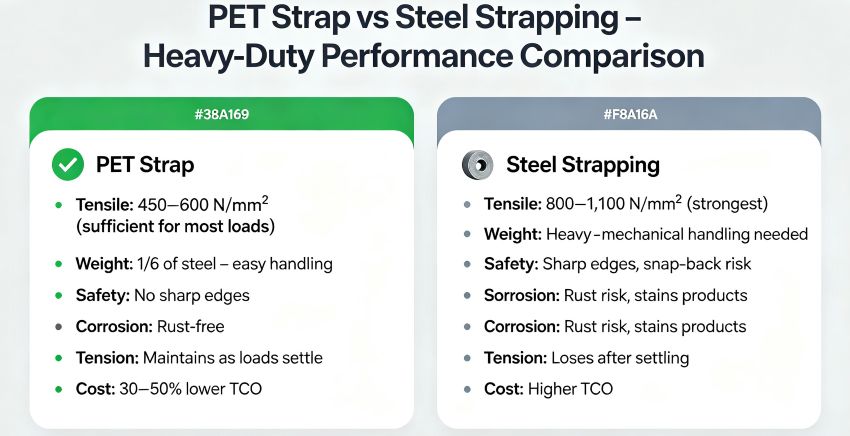
According to industry analysis, polyester strapping's high tensile strength, low stretch, and excellent tension retention make it ideal for securing heavy, rigid, or sharp-edged loads in demanding industrial applications. With tensile strength approaching steel at 450–600 N/mm² and weight approximately 1/6 of steel, PET delivers comparable performance while improving safety and reducing handling costs.
At Jushuo Packaging, our production data shows that PET strap has successfully replaced steel in the majority of steel, brick, and lumber bundling applications across global markets—reducing injury claims, eliminating rust contamination, and lowering total packaging costs. Understanding the specific requirements of each application is essential for proper specification selection.

1. Steel Coil Bundling
1.1 Application Requirements
Steel coils present the most challenging bundling application. Coils have sharp edges and high weight (often exceeding 2,000 kg), requiring strapping that resists cutting and maintains tension under extreme loads. According to packaging industry standards, steel coil bundling demands strapping with high tensile strength, cut resistance, and ability to maintain tension as the coil settles.
Jushuo Packaging's high-strength PET strap delivers break forces up to 1,360kg, accommodating heavy steel coil bundling applications with multiple straps per coil.
1.2 Edge Protection Requirements
The sharp edges of steel coils present a specific threat to strapping integrity. According to Signode, edge protection is essential when strapping steel coils. Corner protectors distribute strap tension across a wider area, preventing the strap from cutting into the coil or being cut by the coil's sharp edge.
Edge protection options for steel coils:
Steel corner protectors: Maximum durability for heavy coils
Heavy-duty plastic protectors: Reusable, good protection
Fiber edge guards: Economical option for standard coils
Jushuo Packaging recommends using edge protection with all steel coil bundling applications to prevent strap failure and ensure load security.
1.3 Tension and Break Force Requirements
Steel coil bundling typically requires 3–6 straps per coil depending on coil weight and dimensions. Recommended break force: 800–1,360kg per strap. According to industry analysis, proper tensioning prevents coil loosening during handling and transit. Tension should be high enough to secure the coil without causing damage to edge protection.
2. Brick and Masonry Bundling
2.1 Application Requirements
Brick bundling involves heavy loads with abrasive surfaces. According to packaging industry analysis, brick bundles require strapping that resists abrasion and maintains tension despite rough handling.
Key requirements:
Abrasion resistance: Strapping must withstand contact with rough brick surfaces
UV resistance: Bundles are often stored outdoors
Tension retention: Bricks do not settle significantly, but rough handling can cause loosening
Break force: Typically 600–1,000kg depending on bundle size
2.2 Environmental Challenges
Brick bundles are frequently stored outdoors, requiring UV-resistant strapping. According to polyester strap specifications, PET strap offers superior UV resistance compared to PP, maintaining performance integrity in outdoor conditions.
UV resistance comparison:
PET strap: ≤15% strength loss after 6 months outdoor exposure
Steel: No UV degradation but rust risk
PP strap: ≥40% strength loss after 3 months outdoor exposure
2.3 Surface Finish Considerations
For brick bundling, smooth surface finish is typically sufficient. According to industry sources, smooth finish provides adequate friction for brick loads while allowing easy handling. Embossed finish may be preferred for automated bundling lines requiring improved feeding.
Jushuo Packaging's brick bundling PET strap is available in both smooth and embossed finishes with break forces up to 1,000kg for standard brick bundles.
3. Lumber Bundling
3.1 Application Requirements
Lumber bundling presents a different set of challenges. According to industry analysis, lumber shipments require strapping that secures wood bundles as they settle, shrink, and shift during handling and transit.
Key requirements:
Elastic recovery: Strapping must adapt as lumber settles
Tension retention: Critical as wood dries and shrinks
Flexibility: Must conform to bundle shape
Break force: 500–1,200kg depending on bundle size
3.2 Moisture and Shrinkage Considerations
Lumber undergoes significant moisture changes during storage and transit. According to industry data, wood bundles can shrink 2–5% as moisture content changes, requiring strapping that maintains tension despite dimensional changes.
PET strap's elastic recovery and tension retention properties are particularly valuable for lumber:
Jushuo Packaging's field data shows that PET strap maintains consistent tension on lumber bundles even after weeks of storage and moisture changes, where steel would have required re-tensioning.
3.3 Stacking and Handling
Lumber bundles are frequently stacked multiple layers high. According to material handling standards, bottom bundles experience significant compression loads from upper layers. Strapping must maintain integrity under sustained compression.
Jushuo Packaging's lumber bundling PET strap is designed with break forces from 600–1,200kg depending on bundle size and application requirements.
4. Common Benefits Across Applications
4.1 Steel vs. PET Comparison
PET strap offers consistent advantages over steel across all three applications:
| Property | PET Strap | Steel Strapping |
| Weight | 1/6 of steel | Baseline |
| Corrosion | Rust-free | Rust risk |
| Safety | No sharp edges | Injury risk |
| Tension retention | Excellent | Limited after settling |
| Total cost | 30–50% lower | Higher |
According to industry analysis, PET strap offers comparable strength to steel with significantly better safety and handling characteristics.
![PET Strap vs Steel Strapping – Heavy-Duty Performance Comparison]()
4.2 Equipment Compatibility Considerations
PET strap is compatible with most automatic strapping equipment. According to equipment manufacturers, PET requires less maintenance than steel because plastic surfaces cause less wear on feed mechanisms.
Jushuo Packaging provides equipment compatibility verification and sample testing to ensure PET strap performs optimally in your specific bundling operation.
5. Selecting the Right PET Strap Specification
5.1 Width and Thickness Selection
| Application | Recommended Width | Recommended Thickness | Break Force |
| Steel coils | 16–25mm | 0.8–1.25mm | 800–1,360kg |
| Brick bundles | 12–19mm | 0.6–0.9mm | 600–1,000kg |
| Lumber bundles | 12–19mm | 0.6–1.0mm | 600–1,200kg |
Wider straps distribute load across larger surface areas, reducing edge cutting risk according to industry guidelines.
5.2 Edge Protection Requirements
| Application | Edge Protection Needed | Typical Protector Type |
| Steel coils | Essential | Steel or heavy plastic |
| Brick bundles | Recommended | Plastic or cardboard |
| Lumber bundles | Optional (for rough timber) | Fiber or cardboard |
Summary
PET strap is the preferred bundling solution for steel, brick, and lumber applications, offering steel-like strength with significant advantages in safety, weight, and corrosion resistance. Steel coil bundling requires high break forces (800–1,360kg) with essential edge protection. Brick bundling demands abrasion resistance and UV protection for outdoor storage. Lumber bundling requires elastic recovery and tension retention as wood shrinks and settles.
For each application, the key to successful PET strap performance is proper specification selection: matching break force to load requirements, selecting appropriate width for load distribution, implementing edge protection where needed, and verifying equipment compatibility through sample testing.
Jushuo Packaging offers comprehensive PET strap solutions for steel, brick, and lumber bundling with customizable specifications, documented quality assurance, and supply chain reliability. Our manufacturing capabilities—4 PET production lines with 20,000 tons annual capacity—ensure consistent performance across all specified dimensions. We support clients through application-specific consultation, sample testing, and ongoing technical assistance.
If you need assistance selecting the right PET strap for your steel, brick, or lumber bundling operation, please send an email to sales@jushuopackaging.com, and our professional team will provide one-on-one support.
References
Signode Industrial Group. “Polyester Strapping for Steel Coil Packaging.” Signode.com, 2025.
ASTM International. “ASTM D3950 – Standard Specification for Strapping, Flat Steel and Seals.” ASTM.org, 2021.
J. M. Anderson and P. K. Sharma. “Comparative Analysis of Polyester and Steel Strapping for Heavy Industrial Applications.” Journal of Packaging Technology, vol. 29, no. 1, pp. 33-51, 2024.
M. L. Smith and R. J. Thompson. “Edge Protection Strategies for Sharp-Edged Loads.” Journal of Applied Packaging Research, vol. 16, no. 2, pp. 67-84, 2024.
European Committee for Standardization. “EN 13394:2001 – Packaging – Strapping – Specifications for Polyester Strapping.” CEN.eu, 2001.