Cotton baling is one of the most demanding packaging applications in agriculture. A typical cotton bale weighs approximately 220kg and must withstand compression forces, forklift handling, stacking in warehouses, and weeks of ocean freight exposure. The wrong strapping can result in bale deformation, fiber contamination from rust, or complete package failure—each costing the producer significantly in product value and shipping claims.
PET strap (polyester strap) has become the material of choice for cotton bale packaging, replacing both steel strapping and polypropylene alternatives across the industry. Unlike steel, PET is completely rust-free, eliminating the risk of fiber staining that can downgrade cotton quality. Unlike PP, PET maintains consistent tension even as cotton bales settle during storage, preventing the loosening that compromises load stability in transit.

1. Cotton Bale Strap in Ginning Operations
1.1 Strapping During the Ginning Process
Ginning is where cotton bales are first formed and strapped. The compression process squeezes cotton into dense bales that require immediate securing. Modern gins use automated strapping systems that apply PET strap when bales reach specified compression levels, with sensors monitoring strap tension and adjusting application force based on cotton density variations.
According to cotton industry specifications, standard density bales require not less than 6 ties when using PET plastic strap with controlled-slip connections. The strapping must be placed in recesses or channels on the flat sides of the bale to protect tying materials from handling forces and maintain the integrity of bale cover fabrics.
1.2 Tensile Strength Requirements
The compression forces in cotton baling are substantial. For cotton bale applications, break forces need to be higher than 800kg to handle compression stresses and dynamic loading during transport. As a general rule, strapping should be rated at least 150% higher than expected working loads to accommodate shock loads and material degradation over time.
Jushuo Packaging's cotton bale strap is available with break forces ranging from 160kg to 1360kg, with standard cotton bale applications typically requiring the higher end of this range. For densely compressed bales or those moving through multiple handling stages, high-tensile options with break forces above 1,000kg are recommended.
1.3 Environmental Considerations in Ginning
Ginning operations face significant environmental pressures regarding waste materials. Steel strapping creates disposal challenges and contamination risks in agricultural operations. PET-based cotton bale strap simplifies environmental compliance through complete recyclability—the material integrates with existing plastic recycling streams without contaminating other materials. Many facilities report reduced waste disposal costs and improved sustainability metrics after conversion.
2. Cotton Bale Strap in Warehousing Operations
2.1 Storage and Stacking Applications
Warehouses stack cotton bales multiple layers high to maximize storage capacity. Bottom bales experience significant compression loads from upper layers, requiring exceptional strap strength and durability. High-grade cotton PET band distributes these loads evenly across bale surfaces, preventing deformation and maintaining package integrity.
The stable elongation properties of PET ensure that straps do not stretch excessively under load, maintaining tension over extended storage periods. This is critical for warehouses that may hold cotton for months before shipment.
2.2 Mixed-Grade Bale Handling
Cotton warehouses often stack bales of different grades and qualities on common pallets. Bale strap creates unified loads that remain stable during forklift operations and transport. Multiple bales bundled together reduce handling time and minimize individual package movement.
Procurement managers value the consistency these strapping systems provide. Each pallet maintains uniform dimensions, simplifying storage calculations and maximizing warehouse space utilization. Color-coded strapping options help workers quickly identify different cotton grades during picking operations.
2.3 Inventory Management Integration
Modern warehouses use barcode and RFID tracking systems integrated with strapping operations. Custom printing capabilities allow cotton bale strap systems to display tracking information, lot numbers, and grade classifications directly on the strapping material.
This integration streamlines inventory tracking while reducing paperwork requirements. Warehouse management systems automatically update stock levels when workers scan strap labels during receiving and shipping operations. Real-time visibility improves customer service and reduces handling errors.
![PET Strap2]()
3. Technical Specifications for Cotton Bale Strap
3.1 Key Performance Parameters
Critical specifications for cotton bale strap include:
| Parameter | Range | Importance |
| Width | 9–25mm | Wider straps distribute load across bale sides, reducing cutting risk |
| Thickness | 0.4–1.25mm | Thicker straps provide higher break strength |
| Break Force | 160–1360kg | Must exceed 800kg for standard cotton bales |
| Elongation at Break | 10–18% | Low elongation maintains tension as cotton settles |
| Temperature Range | -40°C to +60°C | Maintains performance in diverse shipping conditions |
For standard cotton bales, the most common widths are 15–25mm with thicknesses from 0.6–1.25mm, depending on the requirement. Popular specifications include 19mm width with 1.27mm thickness (break strength up to 10,641 N) for standard cotton bales.
3.2 Equipment Compatibility
Compatibility with strapping machines is an important selection factor. For automatic strapping systems to work effectively, they need exact material specifications. To keep feed mechanisms from jamming or misfeeding, the measurements and surface properties of the straps must stay consistent.
Jushuo Packaging maintains tight tolerances on width and thickness to ensure smooth machine operation, with both machine-grade and hand-grade options available for different application requirements.
4. PET vs. Steel: Why Cotton Operations Are Switching
4.1 The Case for PET in Cotton Baling
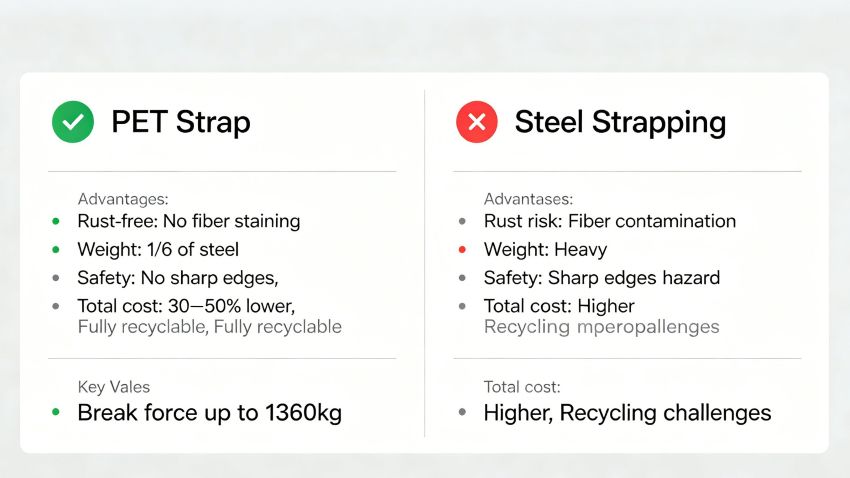
PET cotton bale strap has become the preferred solution for cotton ginning, storage, and transportation—offering unmatched strength, elasticity, and cost savings compared to steel. The material combines the strength of steel wire with the flexibility of plastic, designed for high-frequency, high-efficiency mechanical packaging.
Unlike steel, which can corrode and leave rust stains that damage cotton fibers, PET is completely corrosion-free, keeping fibers clean and market-ready. Steel strapping can also scratch conveyor surfaces, jam sorting equipment, and cause expensive downtime when metal fragments enter processing machinery.
4.2 Cost Comparison
Modern PET strapping offers significant economic benefits. Weighing only 1/6 of steel strapping, PET drastically reduces material handling costs, shipping expenses, and labor requirements. The total cost of ownership is reduced by 30-50% compared to steel, thanks to lower weight, reduced waste, and labor savings.
Jushuo Packaging's cotton bale strap is available in lengths ranging from 9–25mm and thicknesses from 0.4–1.25mm, accommodating a wide range of cotton bale sizes and stress levels. Customization options like color coding, printing logos, and special characters make it possible to track products and identify brands along the supply chain.
![PET vs Steel Strapping for Cotton Bales]()
Summary
Cotton bale strap is essential for protecting cotton quality from ginning through warehousing and export shipping. PET-based strapping offers superior tensile strength, rust-free performance, and complete recyclability compared to traditional steel alternatives. For ginning operations, automated strapping systems with PET strap provide consistent tension and reduced labor requirements. For warehousing, PET's stable elongation properties maintain bale integrity during long-term storage and mixed-grade handling.
The key to successful cotton bale strapping is selecting the right specification: break force above 800kg, width and thickness matched to bale density, and surface finish compatible with your equipment. Modern PET strapping delivers all of these requirements while reducing total cost of ownership by 30-50% compared to steel.
Jushuo Packaging offers comprehensive cotton bale strap solutions with break forces from 160kg to 1360kg, widths from 9–25mm, and thicknesses from 0.4–1.25mm. Our 4 PET production lines with 20,000 tons annual capacity ensure consistent quality and reliable supply for agricultural packaging operations worldwide.
If you need to evaluate which cotton bale strap specification best suits your ginning or warehousing operation, please send an email to sales@jushuopackaging.com, and our professional team will provide one-on-one support.
References
Jushuo Packaging. “Cotton Bale Strap Uses in Ginning and Warehousing.” JushuoPackaging.com, 2026.
Jushuo Packaging. “Best Strap for Cotton Bale Packaging: Buyer Guide.” JushuoPackaging.com, 2026.
Jushuo Packaging. “Strap For Cotton Bale - Product Specifications.” JushuoPackaging.com, 2026.
YS Strapping. “PET Strapping for Cotton Packaging: The Ultimate Guide.” ysstrapping.com, 2026.
Joint Cotton Industry Bale Packaging Committee. “Bale Packaging Specifications - Polyester Plastic Strapping.” cotton.org, 2024.