The Procurement Challenge
Cotton bale packaging demands strapping that withstands compression forces, multiple handling stages, and long transit times. According to JCIBPC specifications, PET plastic strapping must meet minimum break strength requirements—3,200 pounds for gin standard density bales and 4,000 pounds for gin universal density bales, with the strapping placed in recesses or channels on the flat sides of the bale to protect tying materials from handling forces . The choice of strap for cotton bale applications directly affects cotton quality, export compliance, and operational reliability.
At Jushuo Packaging, our engagement with cotton ginners and exporters shows that systematic procurement prevents costly specification mismatches and supply disruptions. This guide covers the key areas buyers should evaluate when procuring strap for cotton bale applications.
1. Understanding Cotton Bale Strap Specifications
1.1 Break Force Requirements
Break force is the most critical specification for cotton bale strap. According to JCIBPC standards, PET strapping for gin standard and gin universal density bales must have an average break strength of not less than 2,400 to 4,000 pounds depending on bale type . For cotton bale applications, break forces need to exceed 800kg to handle compression stresses and dynamic loading during transport. As a general rule, strapping should be rated at least 150% higher than expected working loads to accommodate shock loads and material degradation over time .
1.2 Width and Thickness Specifications
Width and thickness parameters affect both strength and equipment compatibility. Wider strapping better distributes load across bale sides, reducing the risk of cutting and edge damage. For cotton applications, the most common widths are 15–25mm with thicknesses from 0.6–1.25mm depending on requirements .
Key specification shorthand:
190127: 19.0mm width × 1.27mm thickness
190140: 19.0mm width × 1.40mm thickness
160100: 16.0mm width × 1.00mm thickness
1.3 Elongation and Environmental Resistance
Low elongation PET strapping maintains consistent tension even when cotton bales settle and moisture content changes. Specifications typically aim for elongation values below 12% at break to ensure dimensional stability . High-quality PET strapping maintains performance across a temperature range from -40°C to +60°C without becoming brittle or softening excessively .
2. Regulatory Compliance: JCIBPC Standards
2.1 Key Compliance Requirements
The Joint Cotton Industry Bale Packaging Committee (JCIBPC) specifications, adopted by the USDA as requirements for CCC loan eligibility, establish critical compliance standards for cotton bale strapping . Key requirements include:
| Requirement | Gin Standard Density | Gin Universal Density |
| Minimum break force | 3,200 lbs (~1,450kg) | 4,000 lbs (~1,814kg) |
| Minimum thickness | 0.025 inch (0.635mm) | 0.031 inch (0.787mm) |
| Minimum width | 0.75 inch (19mm) | 0.75 inch (19mm) |
For controlled-slip PET strapping, connections must permit up to 5 inches of relative movement at a minimum of 2,000 pounds of initial frictional force .
2.2 Certification and Documentation
According to JCIBPC specifications, each coil of PET strapping shall bear a certification that the strapping has been manufactured according to specifications, showing the name and address of the manufacturer and containing a quality control code that will permit the strapping to be identified to the coil or strapping carrier . Plastic strapping must be fabricated within a NAFTA country .
3. Supplier Evaluation Criteria
3.1 Manufacturing Capabilities
When evaluating cotton bale strap suppliers, consider:
In-house manufacturing: Full control over extrusion and stretching processes
Annual production capacity: 10,000–20,000+ tons for reliable supply
Quality control: 99%+ pass rates with documented testing
Production lines: Multiple lines for supply continuity
Jushuo Packaging operates 4 PET production lines with 20,000 tons annual capacity, SSP viscosity control, and rigorous quality assurance systems achieving 99%+ pass rates .
3.2 Quality Verification
Quality testing procedures distinguish professional suppliers from commodity providers. Comprehensive testing should include tensile strength verification, elongation measurement, UV resistance evaluation, and temperature cycling tests. Jushuo Packaging's lab data shows that consistent thickness control significantly reduces feeding interruptions in automated packaging systems.
4. Cost Analysis and Total Ownership
4.1 PET vs. Steel Cost Comparison
| Criteria | PET Strap | Steel Strapping |
| Weight | 1/6 of steel | Baseline |
| Corrosion | Rust-free | Rust risk; stains cotton |
| Safety | No sharp edges | Injury risk |
| Total cost | 30–50% lower | Higher |
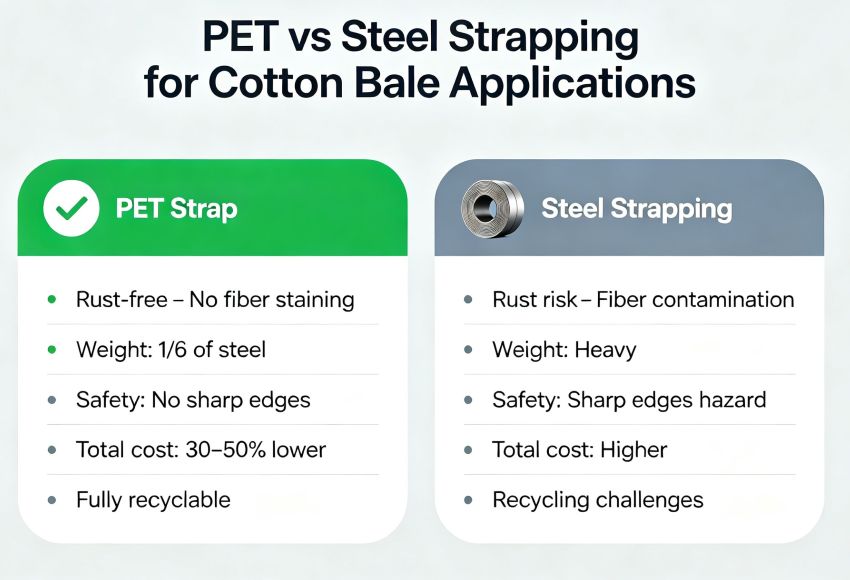
A full cost analysis looks beyond initial material prices to include installation, maintenance, and operational costs. The lighter weight of PET strapping reduces worker fatigue and injury risks compared to heavy steel options . PET strap band is about 85% lighter than steel strapping of the same size, saving freight costs over time .
4.2 Equipment Maintenance Impact
Different strapping types have very different rates of equipment wear. Because steel is rough, tensioning and sealing tools wear out faster. The smooth surface of PET makes equipment last longer and requires less upkeep . Unlike steel, PET doesn't need to be protected from rusting or stored in a certain way, simplifying warehouse operations .
5. Industry Survey Insights
According to a global industry survey, PET straps are perceived as easier to remove, work with, and handle safely compared to steel wire ties. While wire ties are slightly more durable than PET straps, they are not as easy to remove, work with, or handle safely . Key purchase factors rated highly by buyers include:
The strap does not contaminate the bale (73% rated 9/10)
The strap is durable (62% rated 9/10)
The strap is easy to remove (61% rated 9/10)
Summary
Procuring strap for cotton bale applications requires systematic attention to break force requirements, JCIBPC compliance, supplier capabilities, and total cost considerations. JCIBPC standards establish minimum break force of 3,200–4,000 pounds depending on bale type, with specific width and thickness requirements.
PET strapping offers significant advantages over steel alternatives—eliminating rust contamination, reducing weight by approximately 85%, improving worker safety, and providing better tension retention as bales settle during storage and transit. Total cost of ownership is typically 30–50% lower with PET compared to steel.
Jushuo Packaging offers comprehensive cotton bale strap solutions with customizable specifications, documented quality assurance, and JCIBPC-compliant products. Our manufacturing capabilities—4 PET production lines with 20,000 tons annual capacity—ensure consistent performance across all specified dimensions. We support cotton ginners and exporters through every stage of the procurement process.
If you need assistance with cotton bale strap procurement or have questions about specification requirements, please send an email to sales@jushuopackaging.com, and our professional team will provide one-on-one support.
References
Joint Cotton Industry Bale Packaging Committee. “Bale Packaging Specifications – Polyester Plastic Strapping.” cotton.org, 2024.
ASTM International. “ASTM D3950 – Standard Specification for Strapping, Flat Steel and Seals.” ASTM.org, 2021.
European Committee for Standardization. “EN 13394:2001 – Packaging – Strapping – Specifications for Polyester Strapping.” CEN.eu, 2001.
National Cotton Council. “Industry Mill Survey Report – Bale Tie/Strap Material Preferences.” cotton.org, 2024.
JCIBPC/USDA. “Cotton Bale Packaging Materials Specifications – Definitions and Requirements.” cotton.org, 2025.

 English
 العربية
 Français
 Русский
 Español
 Português
 Deutsch
 italiano
 日本語
日本語 한국어
한국어 Nederlands
 Tiếng Việt
 ไทย
ไทย Polski
 Türkçe
 አማርኛ
አማርኛ ພາສາລາວ
 ភាសាខ្មែរ
 Bahasa Melayu
 ဗမာစာ
ဗမာစာ தமிழ்
தமிழ் Filipino
 Bahasa Indonesia
 magyar
 Română
 Čeština
 Монгол
 қазақ
қазақ Српски
 हिन्दी
 فارسی
فارسی Kiswahili
 Slovenčina
 Slovenščina
 Norsk
Norsk Svenska
 українська
 Ελληνικά
 Suomi
Suomi Հայերեն
 עברית
עברית Latine
 Dansk
Dansk اردو
اردو Shqip
Shqip বাংলা
বাংলা Hrvatski
 Afrikaans
 Gaeilge
 Eesti keel
 Māori
Māori සිංහල
සිංහල नेपाली
 Oʻzbekcha
 latviešu
 অসমীয়া
 Aymara
 Azərbaycan dili
 Bamanankan
 Euskara
 Беларуская мова
 भोजपुरी
 Bosanski
 Български
 Català
 Cebuano
 Corsu
Corsu ދިވެހި
 डोग्रिड ने दी
 Esperanto
 Eʋegbe
 Frysk
Frysk Galego
 ქართული
 guarani
 ગુજરાતી
 Kreyòl ayisyen
 Hausa
Hausa ʻŌlelo Hawaiʻi
 Hmoob
Hmoob íslenska
 Igbo
Igbo Ilocano
 Basa Jawa
 ಕನ್ನಡ
ಕನ್ನಡ Kinyarwanda
 गोंगेन हें नांव
 Krio we dɛn kɔl Krio
 Kurdî
Kurdî Kurdî
Kurdî Кыргызча
 Lingala
 Lietuvių
 Oluganda
 Lëtzebuergesch
 Македонски
 मैथिली
 Malagasy
 മലയാളം
 Malti
Malti मराठी
मराठी ꯃꯦꯇꯥꯏ (ꯃꯅꯤꯄꯨꯔꯤ) ꯴.
 Mizo tawng
 Chichewa
 ଓଡ଼ିଆ
ଓଡ଼ିଆ Afaan Oromoo
 پښتو
پښتو ਪੰਜਾਬੀ
 Runasimi
 Gagana Samoa
 संस्कृत
 Gaelo Albannach
 Sepeti
 Sesotho
 chiShona
 سنڌي
سنڌي Soomaali
 Basa Sunda
 Wikang Tagalog
 Тоҷикӣ
 Татарча
 తెలుగు
 ትግንያውያን
 Xitsonga
 Türkmençe
 संस्कृत
 ئۇيغۇرچە
 Cymraeg
 isiXhosa
 ייִדיש
 Yorùbá
 isiZulu


