The Real Cost of PP Strapping
Every packaging buyer wants to reduce costs. But in strapping, the lowest price per roll often conceals a more expensive truth. A strap that feeds poorly, seals inconsistently, or loosens during transit generates costs that never appear on the purchase order—downtime, rework, labor, and damaged goods. Industry analysis shows that a PP strap with consistent gauge and controlled embossing can deliver 20-25% higher system efficiency compared to lower-grade alternatives .
Understanding the real cost of PP strap requires looking beyond the unit price. The manufacturing of PP strap involves factors like raw material quality, viscosity control, and process consistency—all of which affect break force, elongation, and feeding reliability. While polypropylene strapping is the most economical choice for light to medium-duty applications, the performance gap between commodity grades and engineered products can be significant .
![PP Strap2]()
1. Breaking Down the Cost-Performance Equation
1.1 What “Cost” Really Means
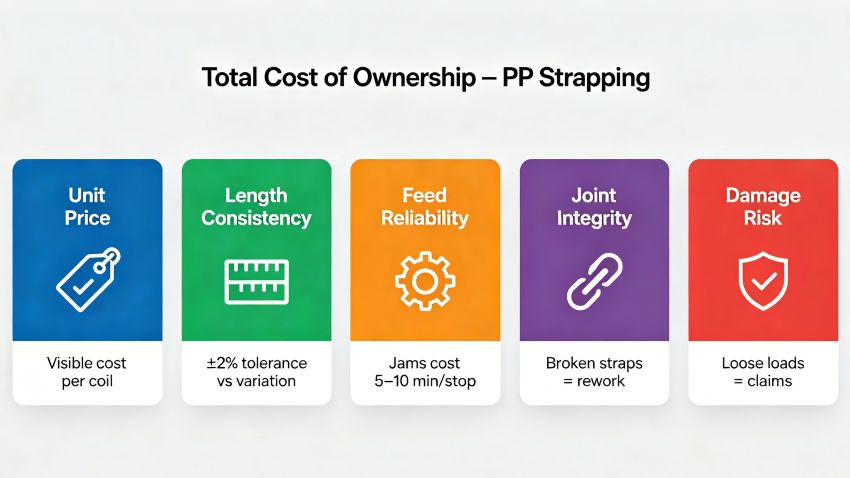
The total cost of PP strap ownership includes:
Unit price per coil: The most visible cost
Coil length consistency: ±2% tolerance vs. significant variation
Feed reliability: Every jam costs 5–10 minutes of line stoppage
Seal integrity: Broken straps add handling time and potential claims
Downtime costs: Lost production from misfeeds and tool adjustments
Damage claims: Loose loads from tension relaxation
The true question isn't “What does this strap cost?” but “What does it cost to run this strap through my operation?”
![Cost components]()
1.2 Performance Factors That Impact Cost
Key performance variables that affect total cost include:
Break strength consistency: A 45–230kg range must match your load requirements
Dimensional accuracy: Width and thickness variation causes feeding issues
Elongation recovery: PP strap has high elongation but limited recovery—once stretched, it stays stretched
Surface finish: Embossed strap feeds better in automatic machines but may cost slightly more
Joint efficiency: Heat-seal consistency affects package security
Jushuo Packaging's quality management includes tensile testing on every production batch, with documented results available to clients to verify performance claims before purchase.
2. When Lower Cost Makes Sense
2.1 Applications Where PP Strap Excels
PP strap delivers optimal value when:
Load weight is under 300kg: PP’s break strength range is sufficient
Package is stable: No significant settling or compression during transit
Handling route is short or controlled: Limited vibration and shock exposure
Speed and material cost matter: High-volume carton bundling and e-commerce workflows
Indoor storage: UV exposure degrades PP—indoor use preserves performance
For these applications, PP strapping provides the most cost-effective solution. According to industry data, PP is usually easier to run in carton and general packaging workflows because it is flexible and widely available in machine-grade rolls .
2.2 The “Good Enough” Threshold
For light-duty applications like corrugated cartons, small bundles, and printed material packs, standard PP strap is entirely adequate. The lower upfront cost translates to real savings without meaningful performance compromise. Many packaging operations can reduce consumable costs significantly by selecting PP strap with specifications that match—rather than exceed—their actual load requirements.
Jushuo Packaging's product line includes PP strap options across the full 5–19mm width range, with break forces from 45kg to 230kg, allowing buyers to select the specification that matches their application without over-specifying.
3. When Performance Matters More
3.1 Hidden Costs of Performance Compromise
Choosing the cheapest PP strap can be a false economy. Performance issues that create hidden costs include:
Stress relaxation: PP strap experiences creep under sustained tension—it gradually stretches and loses tightness during long transit times
Poor feeding reliability: Dimensional variation causes jams and machine stoppages
Inconsistent seals: Weak joints fail under stress, requiring rework
UV degradation: PP can lose 50% of strength after 3–6 months of UV exposure
For export shipments or long-distance transport, the hidden costs of PP strap’s lower tension retention may outweigh its price advantage. Industry case studies show that PP strap on heavy pallets can result in cargo damage that far exceeds any packaging savings .
3.2 When to Consider Alternatives
For operations that demand higher tension retention, switching to PET strap may be the better long-term decision. According to procurement data, PP strapping prices may be worth it for light-duty uses, while polyester strapping usually works better for heavy-duty needs . PET offers better retained tension, higher break strength, and superior UV resistance—but at 30-40% higher material cost .
The choice between materials should be based on load behavior, not just weight. Two pallets can weigh the same but behave differently if one is rigid and square while the other contains compressible cartons or uneven product shapes .
Jushuo Packaging's engineering team provides application consultation to help clients select the right strap specification, considering load type, handling conditions, and cost objectives.
4. Making the Right Decision for Your Operation
4.1 Practical Evaluation Steps
To balance cost and performance effectively:
Test samples in your equipment: Specification sheets don’t reveal feeding behavior
Calculate cost per bundle: Include downtime and failure rates
Match strap to load: Don’t over-specify for light loads or under-specify for heavy ones
Verify supplier quality: Check consistency across batches—not just initial samples
According to packaging industry standards, PP strap is designed for light and medium-duty applications including palletizing, unitizing, bundling, and carton closure . Staying within these application boundaries ensures optimal cost-performance balance.
4.2 Quality Indicators to Look For
When evaluating PP strap suppliers, look for:
Viscosity control: 0.60–0.95 dl/g range indicates consistent material quality
Dimensional tolerance: Tight width and thickness control reduces feeding issues
Break strength documentation: Verified through batch testing
Certifications: ISO 9001, REACH, RoHS compliance
Production capacity: Scale enables consistent quality and reliable supply
Summary
Balancing cost and performance in PP strap procurement requires understanding the real drivers of total cost of ownership. For light-duty applications with stable loads and controlled handling, standard PP strap delivers excellent value. For heavier loads, long-distance transport, or conditions where tension retention is critical, investing in higher-performance PP strap—or switching to PET—can prevent expensive damage claims and operational disruptions.
The smart procurement approach: match strap specification to load requirements, test samples in actual operating conditions, and evaluate suppliers on consistency and quality, not just price per coil.
Jushuo Packaging offers comprehensive PP strap solutions across the full specification range, backed by over ten years of manufacturing expertise, 15,000㎡ production facilities, and rigorous quality control achieving 99%+ pass rates. Our technical team provides application-specific recommendations to help you achieve the optimal balance of cost and performance.
If you need to evaluate which PP strap specification best suits your packaging operation or require assistance with sample testing and cost-performance analysis, please send an email to sales@jushuopackaging.com, and our professional team will provide one-on-one support.
References
Signode Industrial Group. “Empax Polypropylene Strapping (PP) - Product Specifications.” Signode.com.
Stronghold Packaging. “PP Straps That Cut Costs Without Compromise.” shppl.com, 2025.
SelectPack Technologies. “Polypropylene vs PET Strapping for Machine Strapping.” selectpacktech.com, 2026.
Amass Strapping Solutions. “PET, PP, Composite or Woven: Choosing Strapping Materials.” amass-strap.com, 2026.
HB Sub Noor Industries. “PP Strap vs. PET Strap: Which Is Better for Packaging?” hbsubnoor.com, 2026.