The Agricultural Packaging Challenge
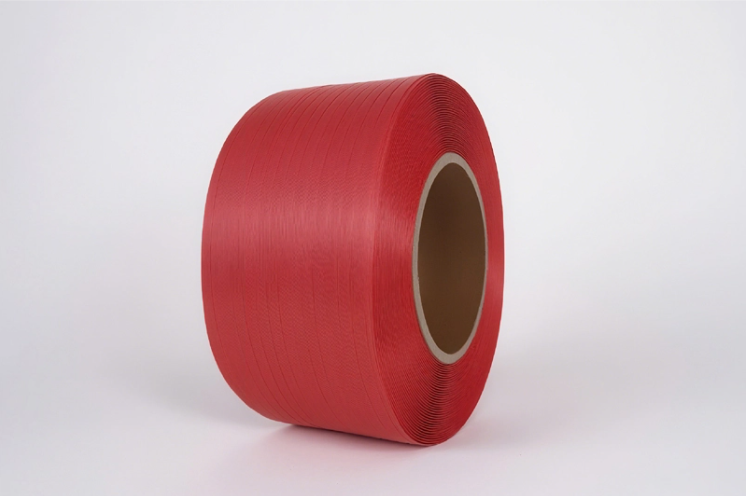
Agriculture presents unique packaging challenges. Hay bales must withstand outdoor storage, cotton bales require rust-free strapping to prevent fiber contamination, and crop bundles need secure strapping that adapts to varying shapes and sizes. PP strapping (polypropylene strapping) has become the preferred solution for many agricultural applications due to its combination of flexibility, cost-effectiveness, and reliability.
At Jushuo Packaging, our production data shows that PP strapping accounts for the majority of strapping used in agricultural packaging across global markets. Its lightweight construction reduces handling fatigue for farm workers, while its flexibility accommodates the irregular shapes common in agricultural products.
1. Key Agricultural Applications
1.1 Hay and Straw Bale Packaging
Hay and straw bales are among the most common agricultural applications for PP strapping. According to industry analysis, PP strapping provides secure closure for hay bales while being flexible enough to accommodate bale compression and settling during storage. The strapping must maintain tension as bales dry and shrink, preventing loosening and bale deformation.
Key requirements for hay bale strapping:
Flexibility: Adapts to bale shape changes during drying
Tension retention: Maintains security as bales settle
UV resistance: Withstands outdoor storage exposure
Cost-effectiveness: High-volume agricultural operations require economical solutions
1.2 Cotton Bale Packaging
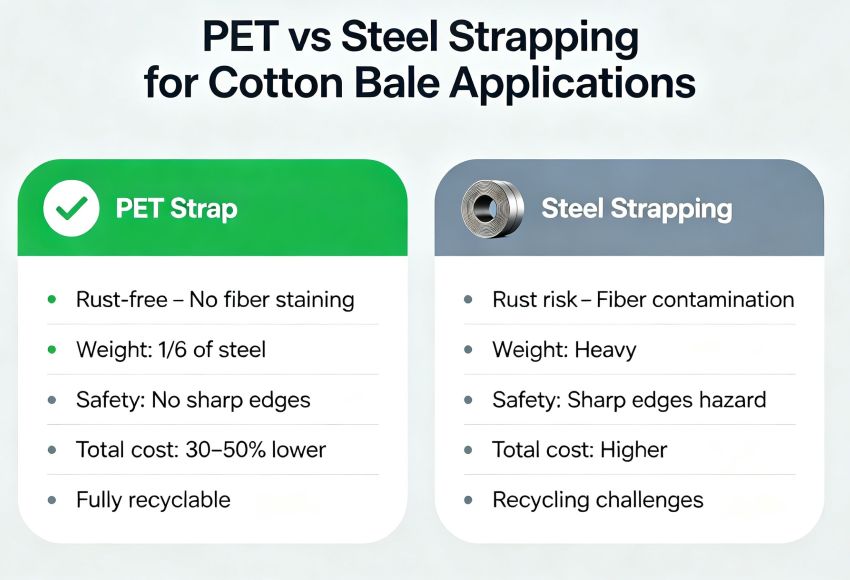
Cotton bales require strapping that is completely rust-free to prevent fiber contamination. According to JCIBPC specifications, PET plastic strapping is preferred for cotton bales due to its rust-free performance, though PP strapping is used in some applications. For cotton operations using PP strapping, break force requirements must be carefully matched to bale density.
1.3 Silage and Forage Packaging
Silage and forage packaging demands strapping that can withstand moisture and maintain tension as the product settles. According to agricultural packaging analysis, PP strapping's moisture resistance and flexibility make it suitable for these applications.
1.4 Crop Bundling and Produce Packaging
Crop bundling—including grains, vegetables, and other produce—benefits from PP strapping's lightweight, easy-to-handle characteristics. According to industry sources, PP strapping is widely used for bundling agricultural products due to its cost-effectiveness and ease of application.
2. Benefits of PP Strapping in Agriculture
2.1 Lightweight and Easy Handling
PP strapping's lightweight nature is particularly valuable in agricultural operations. According to handling safety analysis, farm workers handle strapping frequently, and lighter materials reduce fatigue and injury risk. The weight reduction also lowers shipping costs for agricultural products.
2.2 Flexibility and Adaptability
Agricultural products come in irregular shapes and sizes. According to packaging analysis, PP strapping's flexibility allows it to conform to uneven surfaces without cutting or damaging the product. This adaptability is essential for hay bales, crop bundles, and other irregular agricultural loads.
2.3 Cost-Effectiveness
Agriculture is a cost-sensitive industry. According to procurement analysis, PP strapping offers the most economical solution for high-volume agricultural packaging operations. Lower material costs combined with reduced handling requirements deliver significant savings.
2.4 Moisture Resistance
Agricultural products are often stored outdoors or in humid conditions. According to material specifications, PP strapping resists moisture absorption and maintains performance in wet conditions, unlike some alternative materials that may degrade with moisture exposure.
3. Selection Criteria for Agricultural PP Strapping
3.1 Width Selection
| Agricultural Application | Recommended Width | Reason |
| Small crop bundles | 5–9mm | Light loads, cost efficiency |
| Hay bales | 9–12mm | Balanced strength and coverage |
| Large bales | 12–16mm | Maximum load distribution |
| Cotton bales | 12–19mm | High strength requirements |
3.2 Thickness and Break Force
| Application | Recommended Thickness | Break Force |
| Light crop bundles | 0.35–0.50mm | 45–85kg |
| Standard hay bales | 0.50–0.65mm | 85–150kg |
| Large hay bales | 0.65–0.80mm | 150–230kg |
| Cotton bales | 0.80–1.20mm | 230kg+ |
3.3 Surface Finish
According to industry analysis, embossed PP strapping offers improved feeding in automated baling equipment. For manual operations, smooth finish is typically sufficient.
Jushuo Packaging offers both smooth and embossed PP strapping finishes to accommodate different agricultural equipment and application requirements.
4. Equipment Considerations
4.1 Automatic Baling Equipment
Modern agricultural baling operations use automatic equipment requiring consistent strap dimensions. According to equipment specifications, width and thickness tolerances must be maintained to prevent jams and misfeeds.
4.2 Manual Strapping Operations
Manual strapping operations benefit from PP strapping's flexibility and easy handling. According to operator safety analysis, PP strapping's lightweight construction reduces handling fatigue compared to steel alternatives.
Jushuo Packaging's technical team provides support for both automatic and manual agricultural strapping applications.
5. Environmental Considerations
5.1 UV Resistance
Agricultural products are frequently stored outdoors. According to material specifications, PP strapping can degrade under extended UV exposure, losing significant strength after 3–6 months outdoor exposure . For outdoor storage applications, UV-resistant formulations or PET alternatives may be necessary.
5.2 Recyclability
PP strapping is fully recyclable, supporting agricultural sustainability goals. According to environmental analysis, polypropylene recycling infrastructure is widely available, enabling responsible disposal of used strapping.
Summary
PP strapping plays an essential role in agricultural packaging, securing hay bales, cotton, silage, and crop bundles for storage and transport. Its lightweight construction reduces handling fatigue, while its flexibility accommodates irregular product shapes. Available in widths from 5mm to 19mm and break forces from 45kg to 230kg, PP strapping accommodates a wide range of agricultural applications.
Selection criteria include width, thickness, surface finish, and UV resistance requirements. For outdoor storage applications, UV-resistant formulations should be considered. For high-load applications such as large hay bales or cotton bales, thicker options with higher break forces are recommended.
Jushuo Packaging offers comprehensive PP strapping solutions for agricultural applications with customizable specifications, documented quality assurance, and supply chain reliability. Our manufacturing capabilities—5 PP production lines with 20,000 tons annual capacity—ensure consistent performance across all specified dimensions. We support agricultural operations through every stage of the selection and application process.
If you need assistance selecting the right PP strapping for your agricultural packaging operation, please send an email to sales@jushuopackaging.com, and our professional team will provide one-on-one support.
References
Jushuo Packaging. “PP Strapping in Agricultural Packaging.” JushuoPackaging.com, 2026.
International Organization for Standardization. “ISO 9001:2015 – Quality Management Systems – Requirements.” ISO.org, 2015.
European Committee for Standardization. “EN 13394:2001 – Packaging – Strapping – Specifications for Polypropylene Strapping.” CEN.eu, 2001.
ASTM International. “ASTM D3950 – Standard Specification for Strapping, Flat Steel and Seals.” ASTM.org, 2021.
American Society of Agricultural and Biological Engineers. “ASABE S385 – Agricultural Bale Packaging Standards.” ASABE.org, 2023.

 English
 العربية
 Français
 Русский
 Español
 Português
 Deutsch
 italiano
 日本語
日本語 한국어
한국어 Nederlands
 Tiếng Việt
 ไทย
ไทย Polski
 Türkçe
 አማርኛ
አማርኛ ພາສາລາວ
 ភាសាខ្មែរ
 Bahasa Melayu
 ဗမာစာ
ဗမာစာ தமிழ்
தமிழ் Filipino
 Bahasa Indonesia
 magyar
 Română
 Čeština
 Монгол
 қазақ
қазақ Српски
 हिन्दी
 فارسی
فارسی Kiswahili
 Slovenčina
 Slovenščina
 Norsk
Norsk Svenska
 українська
 Ελληνικά
 Suomi
Suomi Հայերեն
 עברית
עברית Latine
 Dansk
Dansk اردو
اردو Shqip
Shqip বাংলা
বাংলা Hrvatski
 Afrikaans
 Gaeilge
 Eesti keel
 Māori
Māori සිංහල
සිංහල नेपाली
 Oʻzbekcha
 latviešu
 অসমীয়া
 Aymara
 Azərbaycan dili
 Bamanankan
 Euskara
 Беларуская мова
 भोजपुरी
 Bosanski
 Български
 Català
 Cebuano
 Corsu
Corsu ދިވެހި
 डोग्रिड ने दी
 Esperanto
 Eʋegbe
 Frysk
Frysk Galego
 ქართული
 guarani
 ગુજરાતી
 Kreyòl ayisyen
 Hausa
Hausa ʻŌlelo Hawaiʻi
 Hmoob
Hmoob íslenska
 Igbo
Igbo Ilocano
 Basa Jawa
 ಕನ್ನಡ
ಕನ್ನಡ Kinyarwanda
 गोंगेन हें नांव
 Krio we dɛn kɔl Krio
 Kurdî
Kurdî Kurdî
Kurdî Кыргызча
 Lingala
 Lietuvių
 Oluganda
 Lëtzebuergesch
 Македонски
 मैथिली
 Malagasy
 മലയാളം
 Malti
Malti मराठी
मराठी ꯃꯦꯇꯥꯏ (ꯃꯅꯤꯄꯨꯔꯤ) ꯴.
 Mizo tawng
 Chichewa
 ଓଡ଼ିଆ
ଓଡ଼ିଆ Afaan Oromoo
 پښتو
پښتو ਪੰਜਾਬੀ
 Runasimi
 Gagana Samoa
 संस्कृत
 Gaelo Albannach
 Sepeti
 Sesotho
 chiShona
 سنڌي
سنڌي Soomaali
 Basa Sunda
 Wikang Tagalog
 Тоҷикӣ
 Татарча
 తెలుగు
 ትግንያውያን
 Xitsonga
 Türkmençe
 संस्कृत
 ئۇيغۇرچە
 Cymraeg
 isiXhosa
 ייִדיש
 Yorùbá
 isiZulu


